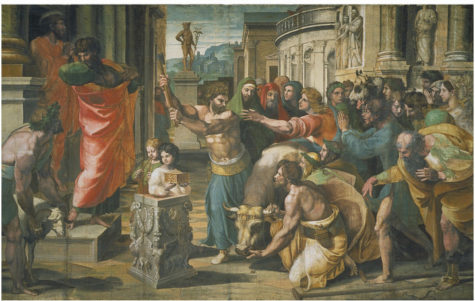
The 23rd of August marks the Ancient Greek holiday of Nemesia, – the festival of the Goddess Nemesis – the Goddess of Fate, Revenge, and Divine Retribution. Blood sacrifices were traditional on this day.
- Note: According to some sources the Nemesia fell on August 21.
This purpose of this festival was to ‘avert the nemesis of the dead’ in order that they could steer away the suffering or punishment of the living.
The goddess Nemesia, very basically, is the Spirit of Retribution against one’s own arrogance before the gods. Because she had this dual-nature, being both fortune and retribution, the Cults would celebrate in her honor to make sure they did not face her fury and could indeed have the gifts of fortune bestowed upon them. In many cases, she was worshiped by generals and gladiators who would pray for strength in combat. But surely this was not all.
She was invoked against those whose hubris and arrogance got the better of them, and served as a force of divine reckoning. She also appears in both Greek and later Roman mythology as an avenging force protecting those who have been violently wronged by their lovers. During the Imperial period of Rome, Nemesis was adopted as a patroness of victorious generals, and of gladiators entering the arena.
The Cult of Nemesia was later associated with Fortuna in Imperial Rome, the cult of Nemesis-Fortuna, which honored Nemesis as the deliberate balance to the random chance of Fortuna’s selections.The all-powerful Nemesia-Fortuna was worshiped by the Freemen of Hadrian and was considered to have a dual-nature about her.
This dual-nature in Nemesia is something which seems to me symbolic of our human nature. We have this spirit of fortune but also this spirit of retribution within us. At least I do.
Sources: State of Information and Pagan Wiccan
2 Responses to The Nemesia
Leave a Reply to Rachel Cancel reply
WD: The Nemesia
zZjayTULbpWTmFwPUUbKcyS: New Moon Magick and Lore
lucy: good-vibes
카지노사이트: The Noumenia
Briar: August Moon Names



I think it's time to go shopping... maybe even buy some really cool stuff at my online shops!!

This is an excellent and accurate description of the Goddess. I enjoyed your choice of words!
The name Nemesis is derived from the Greek “némein,” which meant”to give what is due.”Although the myths accorded to her primarily illustrate her as an agent of divine retribution, Nemesis also brought happiness and good fortune to those who had suffered unduly the harshness of ill fortune. In our mad dash to pain her as a punisher, we forget this. As dispenser of both joy and woe, Nemesis was essentially about the divine demand for balance, and her task was to restore it. Punishment and retribution were simply the are the means by which she brought balance. Unfortunately for us, the men who wrote of her depicted her in such dreadful terms that the name is now associated with implacable envy and emnity. Those aspects became particularly entrenched by the Roman conquerors, who appropriated Nemesis but often syncretized her with the goddesses Invidia (Jealousy) and Aemulatio (Rivalry). What is not acknowledged in this syncretism is that the actions of Nemesis often provoke resentment in those whom she has reckoned. Those are the people most likely to attribute her actions to the jealousy and emnity of the gods rather than their own unjust good fortune or unpunished evil deeds.