Daily Archives: September 23, 2018
About The Swastika Symbol
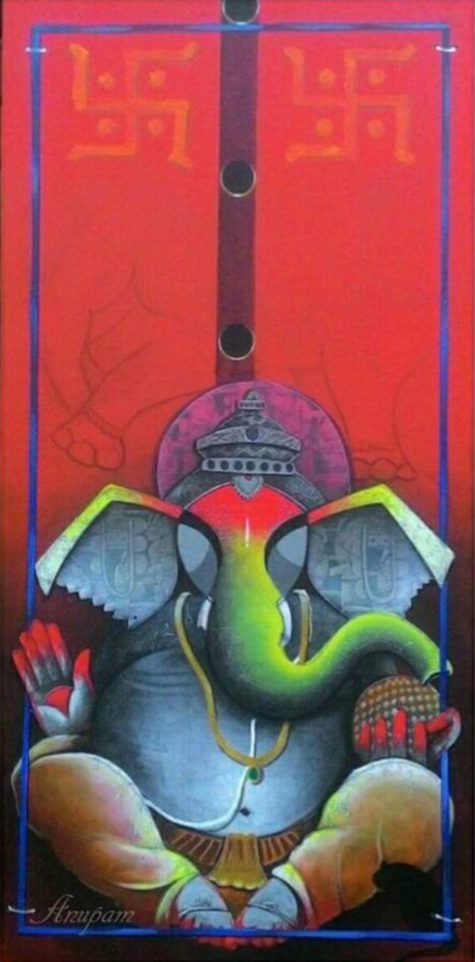
The swastika has been regarded as the symbol for good luck, protection and auspiciousness for over five thousand years in India. It is derived from ‘SU-VASTI’ and means “The essence of all goodness”. For Hindus the swastika is a lucky cross associated with the good fortunes given by Lord Ganesha. It also represents the sun and the cycle of life.
This ancient benign symbol is used today by housewives to guard thresholds and doors, by priests to sanctify ceremonies and offerings and by businessmen to bless the opening pages of account books each New Year’s day. No ceremony or sacrifice is considered complete without it, for it is believed to have the power to ward off misfortune and negative forces.
It is said that the swastika’s right-angled arms reflect the fact that the path toward our objectives is often not straight, but takes unexpected turns. They denote also the indirect way in which Divinity is reached — through intuition and not by intellect. Symbolically, the swastika’s cross is said to represent God and creation.
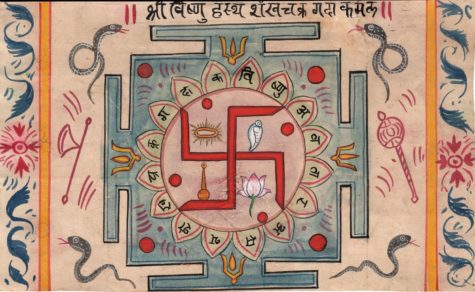
The four bent arms stand for the four human aims:
- Righteousness – dharma
- Wealth – artha
- Love – kama
- Liberation – moksha.
It also represents the world wheel, eternally turning around a fixed center, God. The swastika is associated with the muladhara chakra, the center of consciousness at the base of the spine, and in some yoga schools with the manipura chakra at the navel, the center of the microcosmic sun (surya).
The swastika is a sacred sign of prosperity and auspiciousness, perhaps the single most common emblem in earth cultures. As the Encyclopaedia Britannica explains, “It was a favorite symbol on ancient Mesopotamian coinage; it appeared in early Christian and Byzantine art (where it became known as the gammadion cross because its arms resemble the Greek letter gamma); and it occurred in South and Central America (among the Mayans) and in North America (principally among the Navajos). In India it continues to be the most widely used auspicious symbol of Hindus, Jainas and Buddhists.”
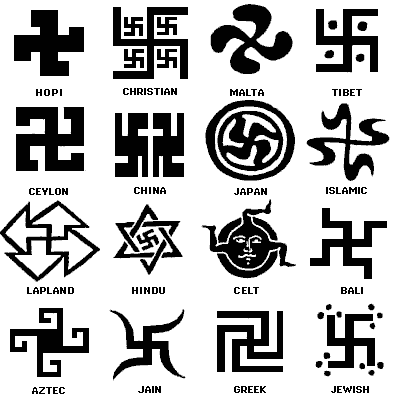
When Buddhism emerged from India’s spiritual wellspring, it inherited the right-angled emblem. Carried by monks, the good-luck design journeyed north over the Himalayas into China, often carved in statues into Buddha’s feet and splayed into a spectrum of decorative meandering or interconnecting swastikas.
On the other side of the planet, American Indians inscribed the spoked sign of good luck into salmon-colored seashells, healing sticks, pottery, woven garments and blankets. Two thousand miles south, the Mayans of the Yucatan chiseled it into temple diagrams.
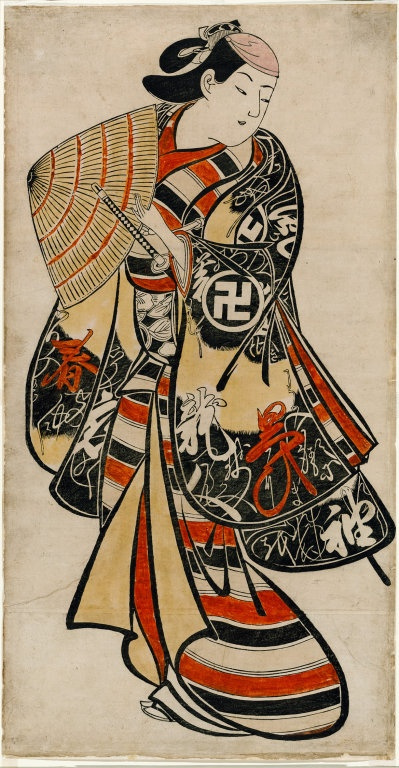
Once moored to the ancient highland cultures of Asia Minor, the emblem later voyaged around the Mediterranean, through Egypt and Greece, south into the African nations, northward into Saxon lands and Scandinavia and west to Scotland and Ireland.
In the 1930s, when Adolf Hitler’s Nazi Third Reich rose to power in Germany and engulfed the planet in World War II, the fortunes of the swastika declined. From September 1935 to the fall of the Nazis in 1945 it was displayed on the Reich’s official flag, a black swastika in a white circle against a red field. German soldiers also wore the hackenkrenz (“hooked cross”) on their uniforms, in a circle beneath an eagle, and displayed it on their armory. In the West it became an infamous, hated symbol of fascism and anti-Semitism and was banned by the Allied Command at the war’s end, though the swastika’s history is as extensive in the West as in Asia.
Because of its infamous association with the Third Reich, the swastika was and still is abhorred by many inside and outside of Germany, still held in disparagement and misunderstanding, which itself is understandable though unfortunate. Now is a time for this to change, for a return to this solar symbol’s pure and happy beginnings. Ironically, even now Hindus managing temples in Germany innocently display on walls and entryways the swastika, the ancient symbol of Lord Ganesha and more recently the hated insigne of Nazism, alongside the shatkona, six-pointed star, the ancient symbol representing God Siva and Lord Karttikeya and as Star of David, the not so ancient but cherished already for centuries emblem of Judaism.

The swastika is an emblem of geometric perfection. In the mind’s eye it can be stable and still or whirl in perpetual motion, its arms rotating one after another like a cosmic pinwheel. It is unknown why and how the term swastika, “may it be good,” was wedded to this most ancient and pervasive of symbols. Most authorities designate the right-hand swastika as a solar emblem, capturing the sun’s path from east to west, a clockwise motion. One theory says it represents the outward dispersion of the universe.
One of its finest meanings is that transcendent reality is not attained directly through the logic of the mind, but indirectly and mysteriously through the intuitive, cosmic mind. Though Hindus use the swastika straight up and down, other cultures rotated it at various angles.
From a mystically occult point of view the swastika is a type of yantra, a psychic diagram representing the four-petalled muladhara chakra located at the base of the spine within everyone.
Borrowed from: Sigils Symbols and Signs
The Symbolism of Ganesha
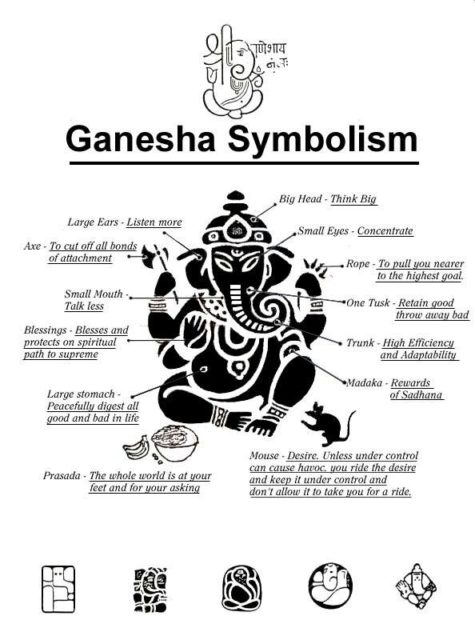
I found this really interesting, and a meditation in and of itself. Definitely food for thought. To view a larger version of the image, click on the picture.
The Significance of Ganesha
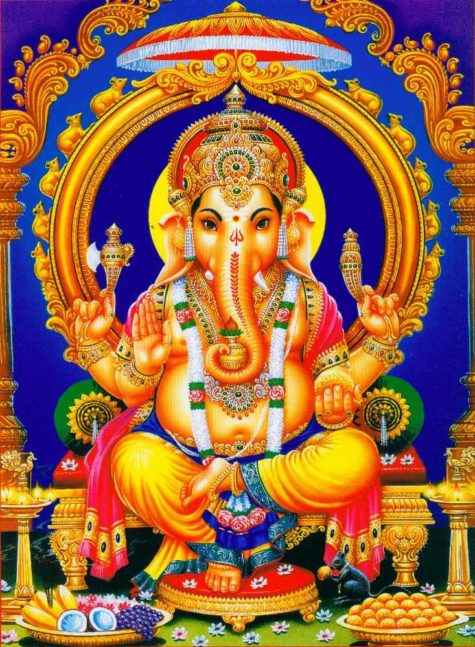
The Divine Mother assumes infinite names and forms, each of which expresses a different facet of Her being. The deity Ganesha, Her first-born son, is a case in point. Ganesh is a compound of the Sanskrit words gana and isha. Gana means “individual beings, independent units, segments of light, discrete bodies of Divinity, unique forces, emanations of Divine Light, attendants of the main deity.” Isha. means “one who is capable of doing what he wishes, capable of refraining from what he does not wish to do, and capable of undoing that which has already been done” – in short, the Almighty Lord.
Ganesha dwells eternally in the womb of the Divine Mother. He is the “firstborn one,” emerging from Her before any of the functioning forces of the universe emerge. In their manifest form all these forces center around this primordial force – Ganesha is the locus for all that exists. He establishes law and brings order out of chaos, causing the universal forces to function coherently.
The first step in bringing order out of chaos is the emergence of the law of gravity, and Ganesha is the presiding deity of that law. At his behest the force of gravity captures all the matter and energy emitted by the primordial Divine Force and gives direction to its outward movement. Ganesha himself is the center of all gravitational energy, and as such he supervises all activities, from the microcosm to the macrocosm-everything in the universe is held by the invisible strings of gravity, while gravity itself is held by Ganesha. The forces of creation, maintenance, and destruction are held in harmonious balance by his will, and that is why this firstborn child of the Divine Mother is called “Ganesha,” the lord of all entities and functioning forces of the universe.
 According to the chakra scheme of kundalini yoga, Ganesha resides in the first chakra, the muladhara. Mula means “original, main”; adhara means “base, foundation.” From the standpoint of manifestation, or outward expansion of the primordial Divine Force, the muladhara chakra is the principle on which everything rests. In his visual form at the muladhara center, Ganesha is described as an enormous man with the head of an elephant. He is heavy and strong, capable of crushing obstacles into dust. Seated at the base of the spine he holds, supports, and guides all other chakras, thus governing the forces that propel the wheel of life.
To understand the symbolic meaning of Ganesha’s personality we have to examine his personified form. Half human and half elephant, he represents human intelligence wedded to the strength of an elephant. The parts of his body are disproportionate: he has big ears, small eyes, a long trunk,a massive belly, and small feet. He is paradox embodied: although he is enormous, his vehicle is a mouse; he consumes huge quantities of food, yet he is an ascetic; he is fat and his legs are short, yet he is master of the dance.
His boundless intelligence is symbolized by his big head.The epithet given to him in both Vedic and tantric scriptures is Brahmanaspati, “lord of knowledge and intelligence” or “lord of pervasiveness.” The scriptures also refer to him as Jyeshtha Raja, “the eldest son,” even though he was never born.
Ganesha’s massive belly symbolizes his capacity to consume and contain the universe that evolves from the Divine Mother. As the lord of gravitational energy he has the capacity to pull anything toward himself and process it as he wishes. He also sets the wheel of karma in motion. That is why the scriptures describe him as Karma Adhyaksha, “the one who presides over karmic law.”
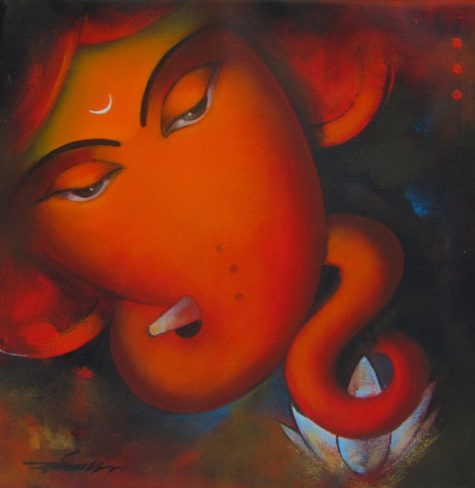
Ganesha is immortal. In him lies the seed of omniscience,and the most subtle mysteries of the universe are known to him, including the mysteries related to our mind, karma, and the cycle of birth and death. The rays of light emanating from him enable us to comprehend our deeply rooted karmic impressions and discover how to attain freedom from the binding forces of our mind. Only then are the obstacles emerging from its unlit corners fully destroyed. Hence he is called Vighnesha, “the lord who removes obstacles.”
Like fire,Ganesha consumes anything in his path with his enormous appetite. He is pleased with any offering we make to him with love – he gladly accepts our problems and concerns and swallows them, granting us freedom once and for all. No force other than Ganesha is capable of consuming our ignorance, egoism, attachment, aversion, and fear of death.That is also why he is called Vighnesha, “the lord who removes obstacles.”
His big ears symbolize his limitless capacity for hearing. He hears our prayers regardless of how we recite them – he does not care whether or not we sing hymns in his praise, he considers our heartbeat and brainwaves to be forms of prayer. Any irregularity, whatever the cause, catches his attention. Being Ganesha, the head of the family, he rushes to our rescue. For these reasons, too, he is known as Vighnesha, “the lord who removes obstacles.”
The fluid that sometimes flows from the temporal gland of male elephants flows constantly from Ganesha, and drawn by its sweet aroma insects drink the nectar. Intoxicated, they buzz around his ears, which he flaps gently in order to ward them off. This tells us metaphorically that Ganesha’s head, the treasure-house of wisdom, is so filled with the sweetness of love and compassion that it flows from him effortlessly and incessantly and is granted even to those who come to him with a noisy mind.
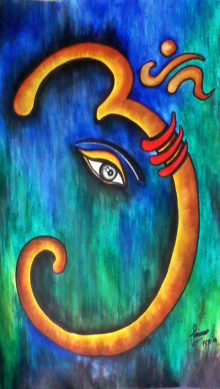 Set in his enormous head, Ganesha’s eyes are small because he has little use for them. However his third eye, the eye of intuition, is wide open, and he sees past, present, and future simultaneously. Seated as he is deep within every living and non-living entity, he sees everything. That is why he is called Adi Rishi, “the primordial seer.” He is the eternal source of knowledge – revelation flows through him. The scriptures refer to him as Parama Guru, “the master of all previous masters.”
The scriptures identify Ganesha with the sacred sound Om, and the shape of his trunk resembles the word written in Sanskrit. Because Om is the source of all mantras, repeating any mantra is tantamount to meditating on Ganesha. All sounds, words, and mantras in their dormant form rest in the muladhara chakra, where Ganesha resides.
The most subtle, vibrationless state of sound in the muladhara chakra is called “para.” At the behest of Ganesha,who presides over gravitational energy, a stirring arises in the muladhara chakra that can be detected only intuitively. This vibrationless vibration can be felt when it reaches the navel center; when it reaches the heart center, it assimilates the power of thinking; and it becomes audible when it reaches the throat center. Ganesha oversees this entire process. Without his assistance and guidance we can neither gain access to the muladhara center nor receive the ensuing revelation.That is why Ganesha is said to be the gatekeeper at the palace of the Divine Mother.
Though Ganesha’s feet are quite small, he outruns all the forces of the universe – because he pervades everything, he is already everywhere. Without moving, the lord of gravitational energy makes everything move. With his enormous body and tiny feet Ganesha dances to the song of the Divine Mother, and exhilarated by his movements, She joins in.Then, as mother and son perform their cosmic dance, all the arts and sciences spring forth. Unable to contain the divine ecstasy, the sages emerge from their absorption in Ganesha and assume their roles as our guides.
This cosmic dance symbolizes the process of kundalini awakening. The forces of darkness can cast their spell of slumber on us only as long as we are outside the pale of this dance. Thus Ganesha, the remover of obstacles, is the one who awakens the divine force in the form of kundalini shakti. He blesses us with shaktipata (the bestowing of divine energy). It is he who sends a sat guru (a true master) into our lives, and through his grace the forces of love, compassion, self-motivation, self-confidence, and determination unfold. Thus the scriptures assert that the door to the Divine Mother’s palace opens when Ganesha is pleased.

There are hundreds of ways to propitiate Ganesha and meditate on him. The tantric method, in conjunction with yantra sadhana, is precise and methodical. Those whose prolonged practice has gained them access to the muladhara center meditate on Ganesha by practicing the tantric method of kundalini yoga. To them, the human body is a yantra. Others draw the yantra of Ganesha on a gold, silver,or copper plate, on a silk cloth, on a wooden board, or on a piece of birch bark, and meditate on that.
From: Warrior of Light (India)
Ganesh and Science
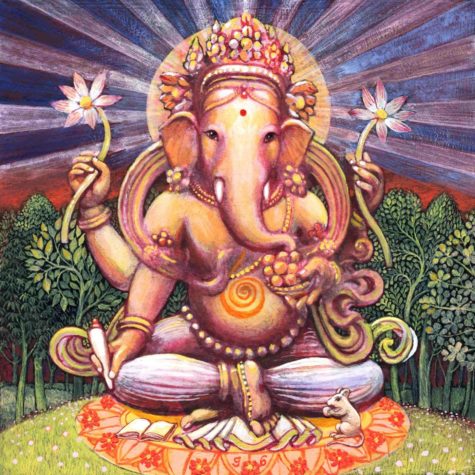
Tradition describes the entire universe as being contained in Lord Ganesha’s big belly. Thus we look upon Him as the overlord who holds sway over the material universe, the sum of cosmic mass. One of His potencies is gravity.
Gravity is a mysterious force to the scientist even today. It is the galactic glue that draws and holds larger mass together and gives order to the macrocosm. It is an instantaneous force, so that when one celestial body moves in a remote corner of a galaxy, all other masses through out the galaxy adjust simultaneously, even though it would take light, at its incredible speed, millions of years to travel the distance.
This implies that space and time are relative concepts and there is “something” that exists everywhere in the universe at once. Like gravity Lord Ganesha is totally predictable and known for orderliness. Without gravity, the known galactic systems could not exist; masses would stray apart; all organization of life as we know it would be impossible. Gravity is the basis of ordered existence in the macrocosm, and our loving Ganesha holds dominion over its mysteries.
Like gravity, Lord Ganesha is always with us, supporting and guiding our physical existence. He is a potent force in the universe, not a representation of potent universal forces. Corpulently built, Lord Ganesha is said to contain within Himself all matter, all mind. He is the very personification of material existence. We look upon this physical world as the body of Lord Ganesha.
In seeing and understanding the varied forces at work in the physical universe, we are seeing and understanding the powers and the being of Lord Ganesha. There is nothing that happens on this material plane of existence except that it is the will of God Shiva and minutely detailed by His beloved son Lord Ganesha. To Him we offer our reverent love and praise.
from Loving Ganesa
by Satguru Sivaya Subramuniyaswami
- Radical Self Care Project Overview by shirleytwofeathers - No Comment
- Radical Self Care Image Gallery by shirleytwofeathers - No Comment
- It’s A Wrap by shirleytwofeathers - 3 Comments
- Something To Consider by shirleytwofeathers - 1 Comment
- Nurturing Your Precious Self by shirleytwofeathers - 3 Comments
B. Joy Barrett: beautiful-turquoise-upholstered-accent-chair-for-living-room-with-within-colorful-accent-chairs-colorful-accent-chairs-transforms-the-look-of-a-room
Claudette Losier: Why Does It Work?
me: Make Your Own Violet Fire
Abdulrahman: Money Chant – Very Fast
Shirley Twofeathers: It’s A Wrap
Our current project began on July 4. We are exploring the concept and practice of Radical Self Care . Feel free to join in at any time!

Interested? You can visit our current project page, or you can take a look at the About The Project page if you are curious about the concept.
.
Please feel free to join in at any time! No experience necessary.
- Money Chant - Fast
- Money Chant - Slow
- Prosperity Plan
- Amazing Creator
- Cause and Effect
- I Am That I Am
- Spirit Rap
- Lakshmi Spirit Rap
- PowWow Spirit Rap
 Enter your question and receive the wisdom of the Occulatum. You may pose your question in any way that feels appropriate. The answer will come in the form of a small pop up. Try it - your life just might change for the better!


I think it's time to go shopping... maybe even buy some really cool stuff at my online shops!!